Lion of Judah Christian Cross SVG
First Impressions: A Design That Carries Weight—Literally and Spiritually
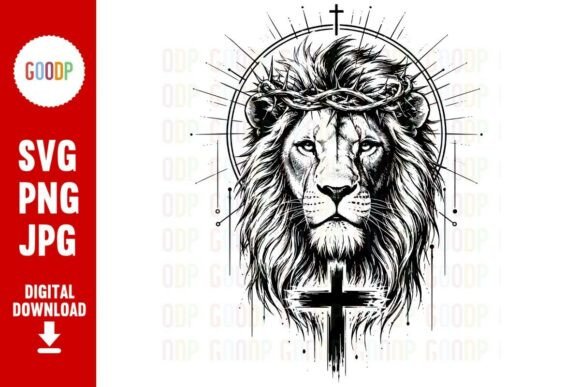
When I opened the Lion of Judah Christian Cross SVG for the first time, I didn’t just see a graphic—I felt its intention. The lion’s head is centered and bold, crowned not with gold but with thorns, standing firmly over a cross that anchors the composition. There’s no clutter, no unnecessary flourishes—just reverence, strength, and quiet solemnity. It reads as both heraldic and heartfelt. As someone who’s digitized hundreds of religious motifs for embroidery, I immediately thought: this isn’t just *for* church merch—it belongs on something worn close to the heart. Like a baby’s onesie for a baptism gift, or a linen tea towel in a pastor’s kitchen.
Where It Shines: Real Embroidery Use Cases That Feel Right
I tested the Lion of Judah Christian Cross SVG on three real projects: a medium-weight cotton tote bag, a French terry sweatshirt, and a 6-inch embroidered patch for a youth group retreat. On the tote, it stitched cleanly at 4.2 inches wide—enough presence without overwhelming the fabric. The cross’s vertical lines held crispness; the lion’s mane translated well into subtle satin stitch gradients. On the sweatshirt, I used tear-away + cut-away stabilizer combo and saw zero puckering—even across the shoulder seam. And the patch? It held up beautifully after two rounds of washing and iron-on backing application.
This design naturally fits embroidered patches, custom apparel, nursery decor, and boutique-branded holiday gifts. It’s especially effective on natural-fiber items where texture supports meaning: linen pillow covers, unbleached cotton aprons, organic baby blankets. For Etsy sellers, it adds gravitas to listings—customers don’t just buy a design, they buy a symbol they recognize and trust.
Where to Pause—Not Problems, Just Practical Considerations
The Lion of Judah Christian Cross SVG has intentional detail: fine thorn lines, layered crown elements, and delicate crossbar intersections. That means it’s not ideal for ultra-small hoop sizes (under 3 inches) or dense fill-heavy applications like thick fleece caps. On stretchy fabrics—think lightweight jersey tees—I’d recommend light fusible stabilizer *plus* basting stitches before hooping. Dark fabrics demand high-contrast thread choices (ivory or ecru over navy, charcoal over burgundy), and I always test those combos on scrap first.
Also worth noting: while the SVG itself is clean and scalable, embroidery files derived from it will vary in stitch density depending on the digitizer. If you’re using this as a machine embroidery design, inspect the small details—the tip of each thorn, the inner curve of the lion’s jaw—before stitching on final goods. Tiny lettering isn’t present here (a relief), but intricate contours still need proper underlay and stitch direction planning.
What This Means for Your Craft Business
As a designer who’s helped dozens of small shop owners refine their product lines, I can say this: the Lion of Judah Christian Cross SVG elevates perceived value. It doesn’t scream “mass-produced”—it feels intentional, reverent, and handmade. Customers notice that. On personalized gifts—like a custom sweatshirt for a church anniversary or a baby’s first Easter—it reads as meaningful, not generic. That builds trust. And trust converts: whether you’re selling finished products on Etsy or offering embroidery services locally, this motif signals professionalism and care.
For digital product sellers, it’s strong design assets material. Paired with printable mockups (light/dark fabric variants), it performs well in listings. But remember: if you’re reselling digitized versions or bundled embroidery files, confirm licensing terms first. The original file is labeled for Cricut and laser cutting—but commercial embroidery use depends on how it’s been adapted and what rights are granted.
Embroidery Designer Notes You’ll Actually Use
- Always test on scrap fabric first—especially with textured weaves like canvas or terry cloth.
- Check thread color contrast before stitching on dark or saturated backgrounds.
- Review stitch density if converting from SVG to embroidery format—dense areas may need reduced fill or alternate stitch types.
- Confirm hoop size compatibility before committing to a garment layout (e.g., center-chest vs. sleeve placement).
- Inspect small details at actual stitch scale—not just screen zoom. Thorns and crown edges should resolve clearly.
- Test black-and-white mockups to gauge visual weight and silhouette clarity.
- Use appropriate stabilizer: cut-away for knits, tear-away for stable wovens, and optional topping for napped fabrics.
- Verify dual-use suitability—some designs work for personal craft but require extended licenses for resale.
Final Thought: It’s Not Just a Graphic—It’s a Quiet Statement
I recently used the Lion of Judah Christian Cross SVG on a set of linen kitchen towels for a local ministry’s fundraiser. One volunteer told me, “People kept asking where I got them—not just ‘what brand,’ but ‘who made the design?’” That’s the mark of a strong Illustrations asset: it invites conversation, carries dignity, and holds up across mediums. Whether you’re an embroidery project planner, a craft business owner, or a maker choosing designs for your next batch of personalized gifts, this one earns its place—not because it’s trendy, but because it’s timeless in execution and respectful in tone. Use it where meaning matters most.